Service
BOAS in Bulldogs, French Bulldogs and Pugs: Evaluation and Treatment in Los Angeles
Brachycephalic Obstructive Airway Syndrome (BOAS) is the reason so many Bulldogs, French Bulldogs and Pugs snore, tire early and struggle in heat: several parts of the upper airway are narrower than they should be, and every breath takes more work. This page explains where the airway narrows, how BOAS looks in each breed, how severity is evaluated by Dr. Antonio Pedraza at Sevilla Veterinary Hospital in Santa Monica, and when brachycephalic airway surgery becomes part of the plan after examination.
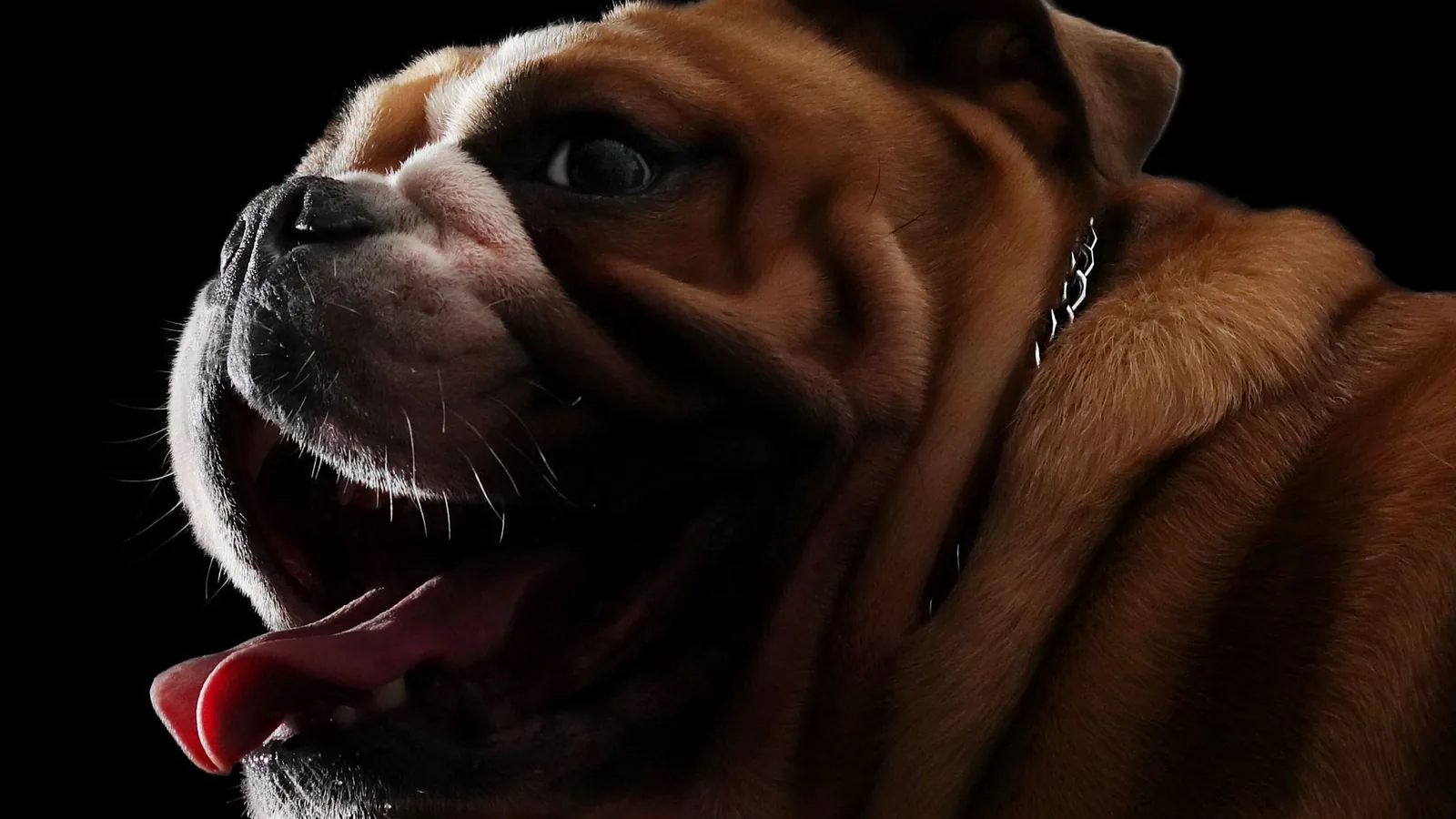
- BOAS is a pattern of several airway narrowings, not one diagnosis — and it tends to progress the longer a dog breathes against it.
- English Bulldogs, French Bulldogs and Pugs each show it differently; the signs your family notices are the starting point of the evaluation.
- Evaluation comes first. When narrow nostrils or an elongated soft palate are clinically significant, airway surgery is discussed as a planned step, with detail on the dedicated procedure page.
Where the airway narrows in BOAS
BOAS is an umbrella term for upper-airway changes that tend to occur together in brachycephalic dogs. A dog can live comfortably with one of them; two or three stacked together turn ordinary breathing into effort. The changes that can be corrected are:
- Stenotic nares — nostrils that are pinched, or that collapse inward on each breath in. The nose is the narrowest point of the airway, so this is often where resistance starts.
- Elongated soft palate — tissue at the back of the mouth that hangs into the airway and vibrates with each breath. It is the source of the classic snore and of much of the effort during sleep and exercise.
- Everted laryngeal saccules — small pouches of tissue pulled into the airway by prolonged forceful breathing. Their presence is a sign the larynx itself is under strain.
Crowded nasal passages, a relatively large tongue, a narrow trachea and laryngeal collapse are also part of the syndrome but are not corrected surgically. Relieving the obstructions above reduces the strain that drives those secondary changes.
External appearance does not show the whole airway. A complete assessment combines history and physical examination with sedated airway examination when clinically appropriate.
How BOAS shows up in each breed
The three breeds most often evaluated for BOAS share the same anatomy problem but rarely present the same way. Knowing what is typical for your dog's breed helps you recognize what is worth reporting at the evaluation.
English Bulldogs
English Bulldogs tend to carry the most stacked set of airway changes: narrow nares, a thick and elongated soft palate and, frequently, a narrow trachea. Families describe loud snoring even while awake, a dog that sleeps sitting up or with a toy in its mouth, gagging or bringing up white foam, and shutting down in warm weather. Because the whole airway is involved, anesthetic planning for this breed is a central part of any airway conversation.
French Bulldogs
Frenchies often present younger, with narrow nostrils as the dominant finding. Owners notice snorting at rest, noisy breathing on short walks, a tongue that darkens after excitement, and reverse sneezing. The airway is proportionally small, so even a modest narrowing has a large effect on a French Bulldog — which is also why correcting it, when indicated, tends to make a noticeable difference. If your Frenchie has breathing problems and you are not sure whether they add up to BOAS, the French Bulldog breathing guide walks through what to look for.
Pugs
In Pugs, pinched nostrils and a very short muzzle are usually the most visible part of the picture. Owners often search for a "nose job" for their Pug; what they mean is correcting the nares. The soft palate is examined at the same time and addressed only if it obstructs. Pugs are also prone to overheating quickly, so heat intolerance is a common first reason for evaluation.
A simple home observation for any of the three: watch your dog asleep. Breathing should be quiet and the belly should move gently. Loud snoring, pauses, or a chest that heaves while the belly stays still are signs the airway is working too hard — worth a video and a conversation.
Exercise, heat, and daytime breathing effort
Many families first notice BOAS when a Bulldog or French Bulldog tires earlier than expected, overheats in warm weather, or works harder to breathe after mild activity. Heat intolerance and exercise intolerance are clinical clues, not proof of a single anatomical cause. They help prioritize a full airway evaluation and lifestyle adjustments while deeper structures are assessed.
Gastrointestinal signs such as regurgitation can accompany increased airway effort in some brachycephalic dogs. Mentioning sleep, exercise, heat response and any GI observations together gives a clearer picture than any one symptom alone. When digestive signs persist on their own, see gastrointestinal endoscopy for bulldogs.
BOAS during sleep
Snoring occurs when tissue vibrates as air passes through a narrowed space. In a brachycephalic dog it is airway obstruction you can hear. It becomes more significant when it is accompanied by repeated waking, breathing pauses or unusual sleeping positions, but snoring by itself does not diagnose BOAS or obstructive sleep apnea.
Sleep behaviors worth mentioning at an evaluation
- Raising the head or extending the neck to settle
- Waking repeatedly and changing position
- Falling asleep while sitting or standing
- Holding an object in the mouth while resting
These patterns are observations to share with a veterinarian, not a diagnostic checklist. Record when they occur and seek urgent care for active breathing distress, collapse, or blue or pale gums.
Dynamic obstruction
Some airway narrowing changes with each breath. Tissue behind the nasal passages or in the pharynx may move inward during inspiration, adding obstruction that cannot be judged from the face or nostrils alone. Selected patients need direct airway evaluation to understand whether dynamic collapse is contributing to their signs.
What an evaluation may include
- Detailed history, weight and body-condition assessment
- Examination focused on nares, oropharynx when visible, and signs of GI involvement
- Discussion of anesthetic risk and brachycephalic-specific planning
- When appropriate, sedated airway examination and imaging
- Coordination with your regular veterinarian when ongoing care is shared
Bring a short video of your dog breathing at rest and after a walk. It is often the most useful thing a family can show at the first visit.
Non-surgical airway management
Not every dog with BOAS signs needs a procedure. Weight management, harness use instead of neck pressure, avoidance of heat and humidity, paced exercise, and careful monitoring of sleep and effort often form the foundation of care. Medical management and timing of any future surgery are planned after the airway picture is clear.
When brachycephalic airway surgery is considered
BOAS is progressive: the harder a dog breathes, the more the soft tissues swell and the more the larynx is pulled out of shape. That is the practical reason evaluation is recommended early rather than after years of loud breathing. When examination shows that narrow nostrils or an elongated soft palate are clinically significant, correcting them is discussed as a planned step for that individual dog — before secondary changes make the picture more complicated.
Families often hear related terms — nose surgery, rhinoplasty, nares surgery, soft palate surgery, breathing surgery. They describe the options that belong in a candidacy conversation, not a checklist every Bulldog or Pug automatically needs. What determines the cost is which of these a dog needs, whether it is combined with another procedure, and the monitoring plan; you receive a written estimate after the exam.
For how those structures are assessed, what the procedures involve, what happens on the day and what recovery looks like, see stenotic nares and soft palate surgery for bulldogs. This hub stays focused on syndrome recognition, severity and planning; the procedure page covers technique-oriented detail.
Airway-aware monitoring
When a procedure is planned, airway support and monitoring are discussed as part of the individual anesthetic plan. The photograph below is educational context for monitoring during care — not a depiction of a specific recommended surgery or promised outcome.
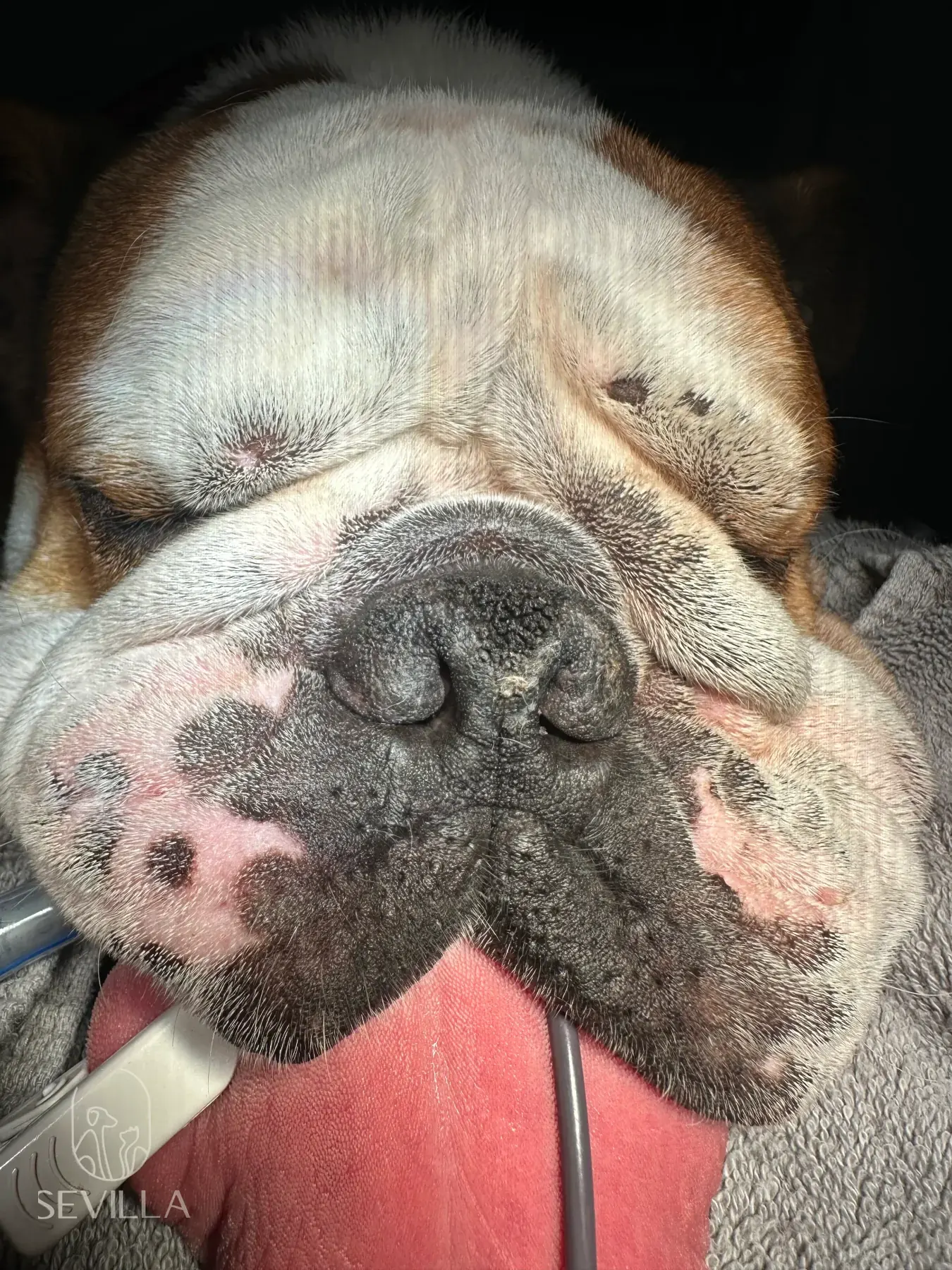
Close view of a Bulldog's face during monitored care. An endotracheal tube and a pulse-oximetry clip are visible. No surgical incision or blood is shown.
Recovery context
After selected procedures, patients may rest under monitoring with fluid support. The short video below is educational recovery context for a French Bulldog in a kennel — not an airway surgery recording and not a promise of any specific recovery course.
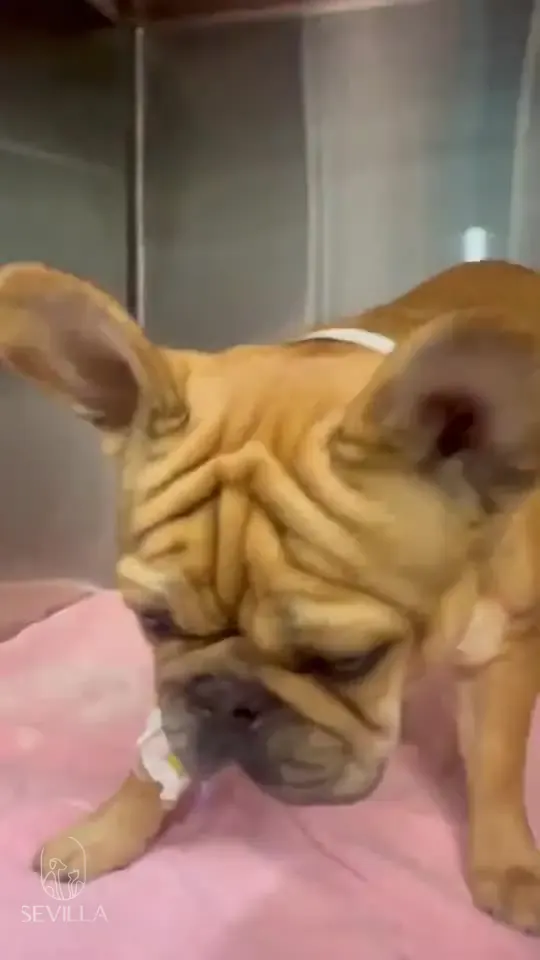
Portrait clip of a French Bulldog lying calmly in a kennel with an intravenous line visible for about eight seconds. No incision, blood, or open procedure is shown.
Surgery as one part of a plan
When clinically significant nares stenosis or an elongated soft palate contribute to signs, surgical options may be appropriate in selected patients after examination. Dogs whose problem is mainly at the nostrils and palate tend to improve most; dogs with advanced laryngeal changes improve less, which is one more reason to evaluate early. Risks, limitations and recovery expectations are reviewed before any decision.
Surgery does not replace weight management, harness use, heat avoidance and careful exercise planning. Those measures often matter whether or not a procedure is chosen.
Anesthesia planning
Anesthesia for brachycephalic breeds requires additional planning before, during, and after any procedure, and the recovery period is watched as closely as the procedure itself. Pre-medication, induction, intubation, monitoring and recovery positioning are tailored to the individual dog. See our dental and anesthesia planning page for related discussion, and meet Dr. Pedraza or request a consultation when you are ready to schedule evaluation.
Recovery and follow-up
If a procedure is selected, recovery is individualized. Most dogs need careful activity restriction, a cool calm environment and monitoring during the first weeks, with planned rechecks. Outcomes depend on anatomy, age, weight, severity, diagnostics and anesthetic risk — no procedure cures every aspect of BOAS or removes all risk. The BOAS surgery recovery guide describes what is normal week by week and what should prompt a call.
Frequently asked questions
What is BOAS?
Brachycephalic Obstructive Airway Syndrome is a pattern of upper airway changes — often including narrow nares and an elongated soft palate — that can affect bulldogs because of their skull shape. Severity varies; many dogs benefit from evaluation even when signs seem mild.
What does BOAS surgery correct?
The procedures grouped under that name open the parts of the upper airway that can be changed: narrow nostrils are widened, an elongated soft palate is shortened and everted laryngeal saccules are removed when present. Which of these a dog needs is decided at examination, not assumed from the breed. Procedure detail is on the dedicated airway procedure page.
Is it the same thing as a dog nose job?
Families often use that phrase, and the nostril part does change how the nose looks. The purpose is functional, not cosmetic: the aim is to move air with less effort. The soft palate, which nobody sees, is often just as important as the nostrils.
My bulldog only snores. Does that matter?
Snoring in a brachycephalic dog is airway noise, and airway noise means tissue is vibrating in a narrowed space. It may be mild today. Because BOAS tends to progress, an evaluation tells you where your dog is now and whether lifestyle measures alone are enough, rather than waiting for louder signs.
What signs matter most day to day?
Loud or labored breathing, heat or exercise intolerance, disturbed sleep, regurgitation related to airway effort, and progressive noise or effort over time are common reasons for evaluation. Severity is judged from the whole picture, not one observation.
Does every bulldog need surgery?
No. Surgery is not automatic. Many dogs benefit from evaluation, weight management, lifestyle planning and medical support first. Surgical options are discussed only when examination suggests they may help a selected patient.
Is there an age limit?
There is no fixed age limit in either direction. Young dogs can be evaluated early, and older dogs are assessed on the state of their airway and their general health rather than their birthday. Age is one factor in anesthetic planning, not a reason on its own to decline evaluation.
Can BOAS cause regurgitation?
Increased breathing effort can go together with regurgitation, gagging or bringing up foam in some brachycephalic dogs. Mention GI signs at the airway evaluation. When they persist or dominate the picture, gastrointestinal endoscopy has its own page and is planned separately.
When should I worry?
Active breathing distress, collapse, blue or gray gums or tongue, severe heat distress, or rapid clinical deterioration need urgent veterinary care — not an online form. Persistent loud breathing, exercise or heat intolerance, regurgitation or sleep disturbance still warrant a timely conversation with a breed-experienced veterinarian.
Related educational resources
These articles answer common owner questions. They do not replace examination or the consultation details on this service page.
Educational references
External sources are linked for further reading. We do not reproduce their text.
Educational information · BOAS & Airway. This page does not replace an examination, diagnosis or case-specific treatment plan from a veterinarian.
Ready to plan your bulldog's care?
Request a consultation and our team will follow up to schedule and review records.